

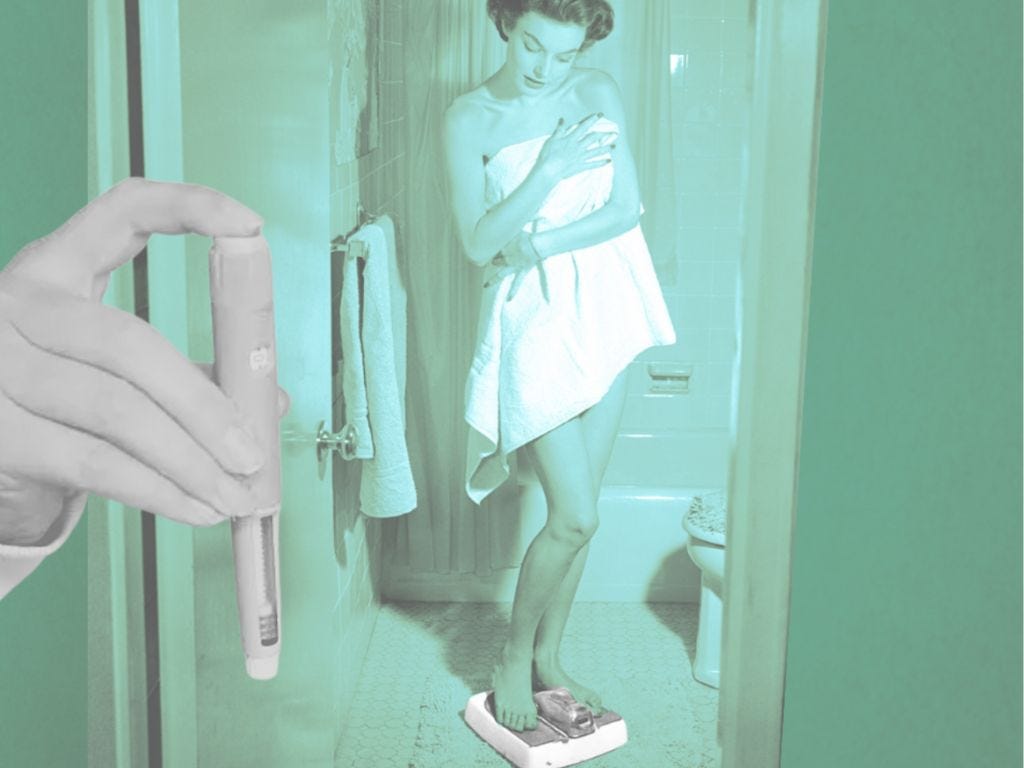
→ Read the full essay on PROVOKED
Editor’s Note: Off-Script—the why, what, and oh sh*t moments behind this article.
Like every woman I know, I have a complicated relationship with my body. More specifically, my weight.
I’ve gained and lost the same 40 pounds across 40 years. I joke that I was born a size 14, but it’s only half a joke. Both my parents were overweight. Most of my extended family was overweight. The genetics weren’t subtle.
I wasn’t paying much attention to GLP-1s when they first came out. I’d heard the chatter the way you hear about anything new in pharmaceuticals, interesting, possibly hyped, probably not for me. Then I sat down with my doctor about an elective surgery I wanted, and she told me my BMI put me at elevated risk. The risk was mine to manage. That was the moment it stopped being an abstract conversation.
I’ve taken GLP-1s for three years now. I lost 40 pounds on Ozempic and I’ve kept it off on a maintenance dose. I’m not going to bury that disclosure at the end of this piece or frame it carefully so it reads as something more defensible. I’m not ashamed of it, and I won’t pretend it doesn’t complicate my position on this subject, because it does.
That’s exactly why I said yes when Wendee Nicole pitched this piece.
She was in the middle of her own mess. She’d done the work, genuinely made peace with her body, stopped letting the scale run her life. Then her mother visited, commented on her weight over pasta, and one month later Wendee started Wegovy. She doesn’t pretend the timing was coincidental.
What she does in this piece is something harder: she sits with the discomfort of wanting something she thought she’d stopped wanting, and asks honestly what that means.
I didn’t want the tidy resolution.
I’ve read enough my journey pieces to know that the ones that wrap up with self-acceptance and a renewed sense of purpose are not always the truest version. What I wanted was the real question, the one most women are navigating quietly right now:
Is choosing weight loss a betrayal of body positivity? Who decided which bodies were allowed to want what? And in midlife, when our bodies are already rewriting the rules without asking, why are we adding more rules on top?
Wendee doesn’t resolve it cleanly because it doesn’t resolve cleanly.
What I will say, and what I think this conversation needs more of: the GLP-1 conversation right now is sensational, complicated, and fraught with defiance on every side. For some of us, it is genuinely a miracle drug—the thing that finally quiets decades of food noise and let us live in our bodies without negotiating every meal. For others, it’s an easy quick fix to drop a dress size before a reunion or a wedding even when you are already a size 4. For the Hollywood elite, it’s something else entirely, and it’s scary to watch. Celebrities shrinking on the runway in ways their faces can’t keep up with. See my piece on the Academy Awards shrinkage. All while the long-term effects of all of this aren’t fully written.
What I’m hopeful about is what’s coming next. Pharma is pushing toward a pill version, faster and cheaper. If it gets safe enough that every woman who needs it can take it the way we take a statin or a blood pressure medication—to keep us healthier, to free us from a lifetime of disease and high risk conditions and of hating ourselves—that’s a win.